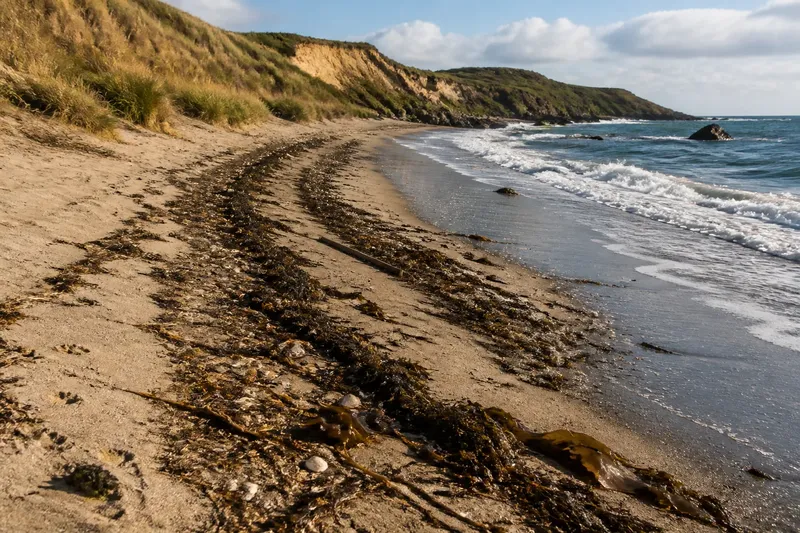
Why Beach Grains Gather in Bands
Why beach grains gather in bands: learn how waves and gravity sort sand and pebbles, and read these shifting patterns without mistaking them for fixed borders.
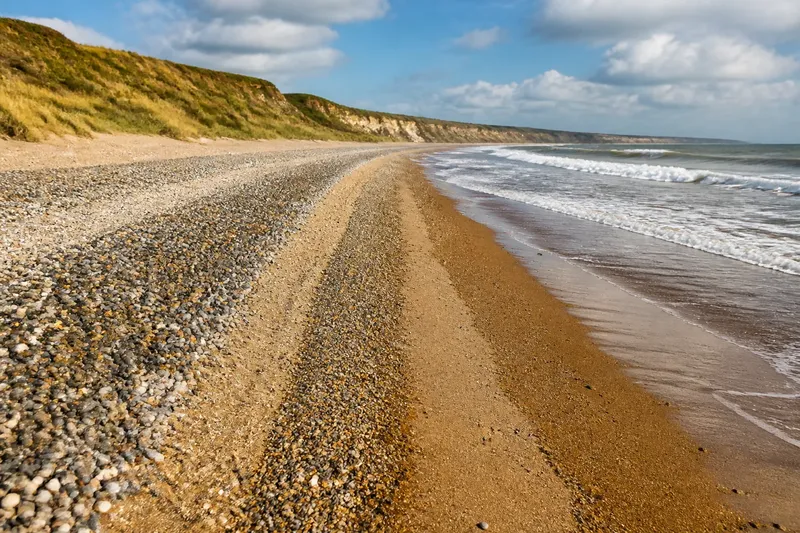
Why beach grains gather in bands becomes clear when you watch a wave run up the shore and drain back. Coarse pebbles may collect near the upper swash, while finer sand lies lower down, forming visible strips that shift as water and weather change.
These bands are not painted lines or permanent divisions. They are temporary records of how water moved, what material was available, and which grains were easiest to carry at that moment. Read them as clues, then check the shape and condition of the beach before drawing conclusions.
What makes beach grains gather in bands?
Waves sort sediment because they move grains with different ease. A grain’s size, shape and density affect how much water movement is needed to lift it or roll it along. When the uprush loses energy, some material settles; when the backwash flows seaward, other grains move with it.
The uprush is the sheet of water that travels up the beach after a wave breaks. The backwash is the return flow down the slope. Their strength and direction are not always equal. On a sloping beach, gravity assists the backwash, while the incoming water can push grains landward. Repeated cycles redistribute material, and sorting becomes visible where the supply and movement create contrasts.
One wave rarely makes a neat band. The pattern usually reflects many waves acting on sediment already present, with each new set changing or blurring what came before.
Look for contrasts between neighbouring patches, not just for a sharp line.
How do waves separate fine sand from pebbles?
Fine sand is easier to suspend than a large pebble, but it can also settle quickly once the water slows. Pebbles are harder to lift, yet waves may roll or push them when enough force reaches the beach. The result depends on both the material and the water’s motion, rather than grain size alone.
In energetic conditions, breaking waves can move coarse material higher up the beach. If the uprush carries pebbles landward and then loses strength, they may settle near the upper limit of the swash. Finer grains may be carried back down by draining water, leaving a coarser strip above and a sandier area below.
Other patterns are possible. A strong backwash can drag sand seaward, while a later wave may move it sideways or back up the beach. A patch of small stones may therefore sit among sand, or the same beach may show several alternating bands rather than one simple division.
Imagine a beach with a pebble-rich upper slope and fine sand lower down. If a run of energetic waves rolls pebbles towards the upper shore while water carries loose sand back down, the expected visible result is a stronger contrast between the two patches. A calmer spell may soften that contrast as finer material settles among the pebbles.
Why do bands sit at different heights?
A band’s height reflects where grains were left behind, not a fixed coastal boundary. Wave reach varies with the incoming waves, the slope of the beach, and the level of water at the time. A strip formed near the upper swash can be reached again by a later wave, while another band may form farther down.
Gravity contributes to this movement, particularly on steep beaches. Loose material tends to move downslope when water drains or grains are disturbed. But the incoming wave can push sediment uphill, and the shape of the beach can redirect flow. The visible position is the outcome of those opposing motions.
Water level also changes during the tide. A band that appears high on the wet beach at one stage may be covered later, and the active swash zone shifts as the water rises or falls. This is why a grain band should not be used by itself to mark the high-water line or to infer how far the sea usually reaches.
Compare the band with the slope and the current wet edge before interpreting its position.
What clues can a grain band reveal about recent conditions?
A band can suggest where waves deposited material or where draining water removed finer grains. A clean contrast between coarse and fine sediment may indicate that water repeatedly moved grains in different ways across the slope. The pattern is evidence of sorting, but not a complete account of the conditions that produced it.
Check several details together:
- Grain size: note whether the band contains sand, granules, pebbles or a mixture.
- Shape: angular fragments and rounded stones may move differently, even when they are similar in size.
- Band direction: see whether it runs parallel to the water’s edge or curves around a low point.
- Beach slope: a steep face and a gently sloping foreshore offer different paths for uprush and backwash.
- Nearby traces: look for small channels, ripples or fresh deposits that show water has recently crossed the patch.
- Condition of the material: wet, settled grains may show a different pattern from loose grains exposed by retreating water.
These observations help distinguish a local deposit from a pattern that continues along the shore. A single band may be interrupted by a stream, rock or change in beach shape; continuity should be checked rather than assumed.
Why do bands fade, shift or disappear?
Beach bands change when the balance between incoming waves, returning water and gravity changes. A stormier spell may move coarse sediment higher or reshape the foreshore. Gentler waves may redistribute loose sand, and a change in water level can cover a band without removing it.
Wind can also disturb dry, fine surface grains, while people, animals and flowing freshwater may break up small patches. These influences do not act evenly across a beach. A band can remain distinct in one sheltered hollow and become mixed into the surrounding sediment a short distance away.
Take a second look after the next tide or change in weather. If the pattern has shifted, that is part of the beach’s behaviour, not evidence that the first reading was mistaken.
Can a grain band mark a permanent beach boundary?
No. A grain band records sediment movement over a particular stretch of time and can be altered or covered by later water. It does not establish a lasting edge between beach zones, nor does its position alone show the full reach of waves during other conditions.
For a careful reading, describe what is visible: the type of grains, their position on the slope, and whether the strip is continuous. Avoid treating the band as a dependable marker for access, property limits or safe distance from the water. Where a decision depends on local conditions or official guidance, use the relevant local information rather than a surface pattern.
Use grain bands as clues to movement, not as boundaries. Their most useful message is that waves and gravity have sorted the beach for now—and that the next set of conditions may sort it differently.